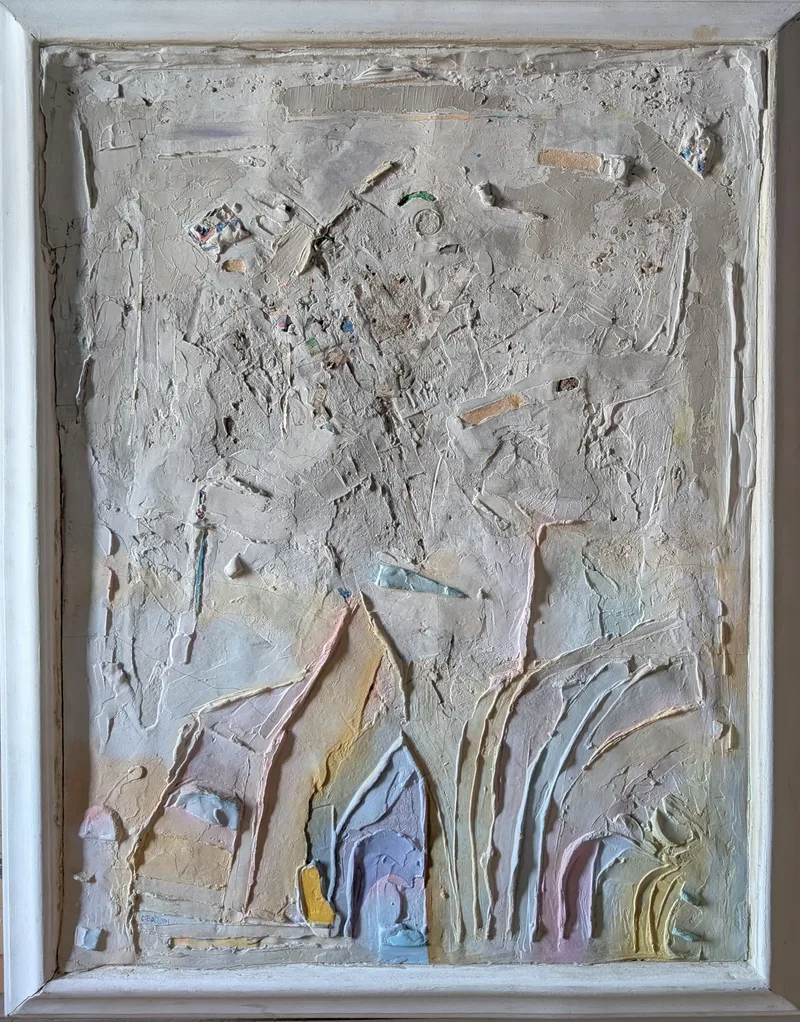
The square support, presented in a diamond orientation, immediately transforms the grammar of space: the four vertices become north, south, east, west of an interior geography. The material - pure cement, raw, without chromatic concessions - constructs a stratigraphic landscape in which the upper section erupts into sharp reliefs, ridges and lacerations that evoke rock formations or the bark of ancient glaciers.
Moving downward toward the centre, the surface stretches into a band of relative quiet: the cement thins, smooths, allowing raking light to filter through in almost silvery reflections that converse with the shadows of the nearby asperities. It is a zone of transition, a threshold between chaos and order, between depth and silence.
In the lower half, circular marks resurface - buried arches, like impressions of a forgotten script that the material has absorbed without entirely erasing them. Deriva Grigia belongs to Bazzoni's reflection on the geological memory of matter: the cement does not imitate stone, it becomes stone, sedimenting time and gesture into a single plastic body suspended between sculpture and painting.